





The Plain of Jars: Laos’ biggest mystery

Today, we take you to Laos’ Plain of Jars: a mystery over 2,000 years old.
1. Overview of Chungm Field
1.1. Where?
On the Xieng Khouang plateau in central Laos, about 250 km southeast of Luang Prabang and about 350 km north of the capital, Vientiane.
1.2. What?
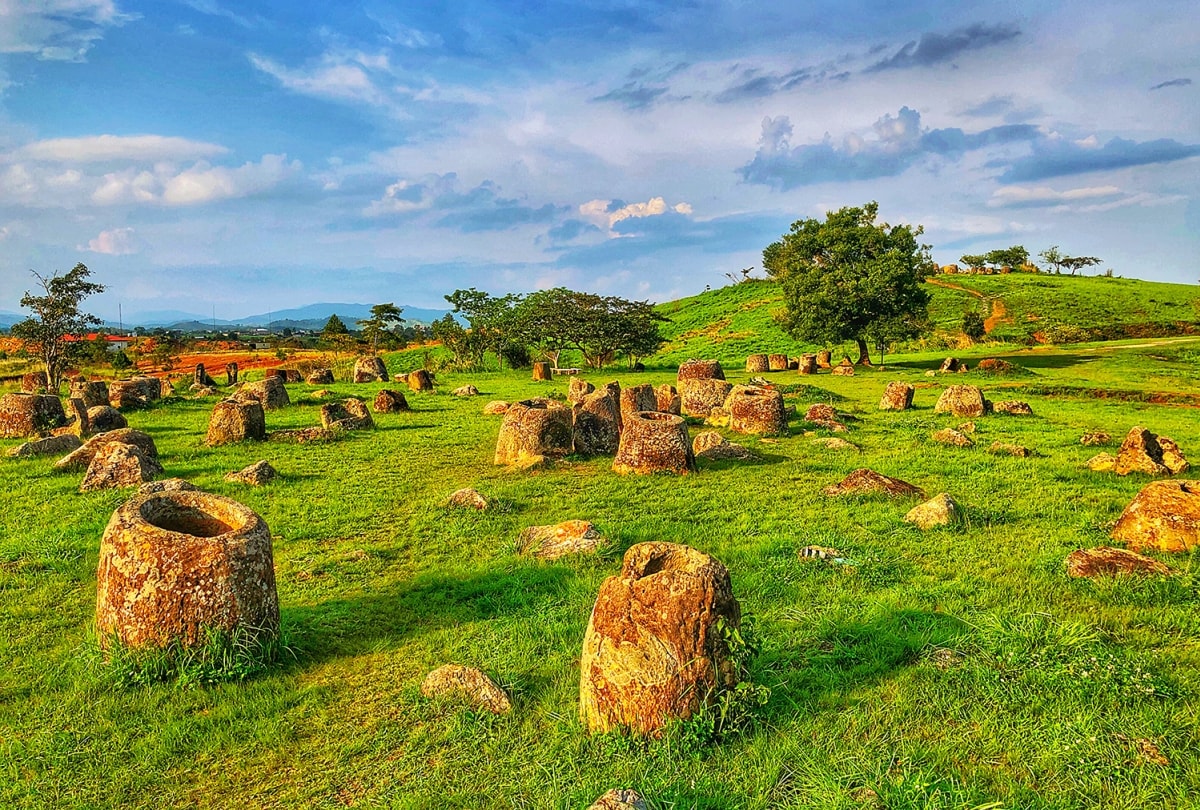
That’s the big question! Superficially, the Plain of Jars is what it says on the tin: a vast area scattered with huge, stone jars. What these jars were built for, exactly, nobody knows – although evidence supports the theory that they were a sort of prehistoric tomb.
The Plain of Jars (Photo: Collected)
1.3. When were they built?
It’s thought that the jars were built during the Iron Age, from 500 BC – 200 AD, however the archaeologist Eiji Nitta has suggested that they could have been built as early as the second millennium BC.
>>> See more: If you’re planning to explore Indochina – especially the captivating country of Laos – check out Focus Asia Travel’s LAOS DISCOVERY TOUR 5D4N!
1.4. How big are they?
There are more than 90 jar sites scattered across hundreds of square kilometres, each containing from one to 400 jars. The jars themselves vary in height and diameter from one metre to three metres, and in total there are around 2,500 jars and jar fragments remaining in the region.
Who built them, and why? It is this mystery that makes Laos’ Plain of Jars so compelling and fascinating. Since research first began in the early 1930s, archaeologists and historians have never managed to agree on which prehistoric civilisation was responsible for these megaliths, nor their purpose – although many theories have been advanced.
1.5. What are they?
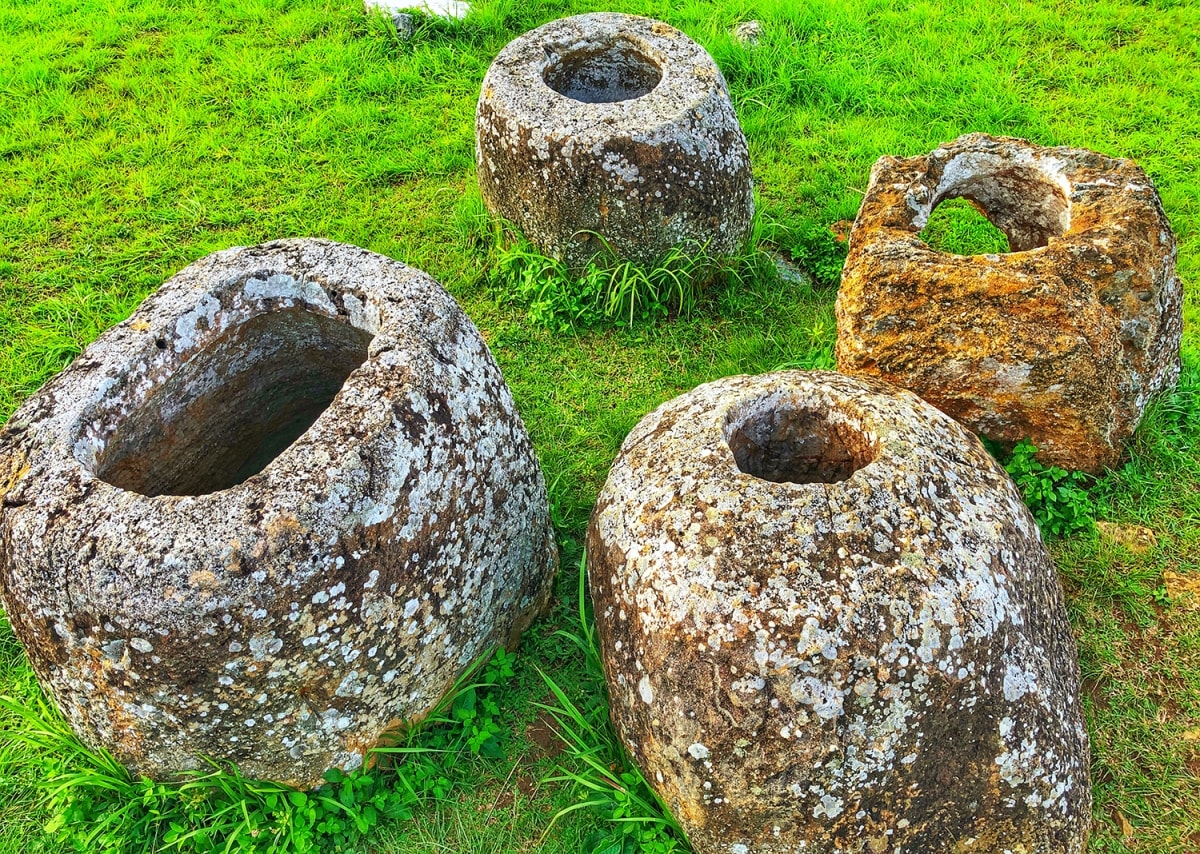
The jars are all hewn from rock (usually sandstone), in a cylindrical shape with the bottom always wider than the top. Of all the thousands of jars in the area, only one bears decoration of any kind: a crouching human form carved in bas-relief on the exterior.
Most of the jars have lip rims, suggesting that all of them had lids at some point. The fact that only a few stone lids have ever been found (and none of them actually on top of a jar) indicates that most of the lids must have been made from perishable materials such as wood.
The stone jars lie on the Plain of Jars (Photo: Collected)
1.6. Who built them?
Though the date of the jars’ construction is thought to have been during the Southeast Asian Iron Age (500 BC-200 AD), little is known about the prehistoric peoples who called Laos home at that time. Some archaeologists (Eiji Nitta, for example) believe that the sites are much older, dating back as far as the second millennium BC.
The civilisation responsible for the Plain of Jars probably used iron tools to craft its jars, and beads and bronze objects foreign to the area have been found – suggesting that it was a wealthy society that profited from its position on trade routes between China, Vietnam and the south.
1.7. What were they for?
The first archaeologists to study the Plain of Jars in the 1930s believed that they played a part in prehistoric burial practices, and what little evidence has been found around the jars does seem to support this theory. Human remains, beads, iron and bronze objects, and ceramics have been found inside and around the jars – some of them burnt, which suggests the practice of cremation. There are also several burial sites found near the jars, marked by stone discs, which may have been contemporary with the jars and connected to them in some way.
Local legends have many more interesting explanations for the existence of the Plain of Jars, however. One such story tells that the area was once home to a race of giants, whose king, Khun Cheung, had the jars constructed to brew rice wine to celebrate victory over his enemies. Another story claims that the jars were made from natural materials such as clay, sand, sugar and animal products before being fired in a giant kiln built inside a cave.
Yet another tradition holds that the jars were constructed to gather monsoon rainwater to supply locals and travellers in areas where fresh water was not readily available. This explanation is more creditable than the race of giants – and could even account for the presence of beads and other objects inside the jars, as travellers could have placed them inside as offerings to bring rainfall.
>>> See more: The World’s Weirdest Dinosaur Museum? Exploring Savannakhet Dinosaur Museum, Laos
1.8. US bombing & present condition
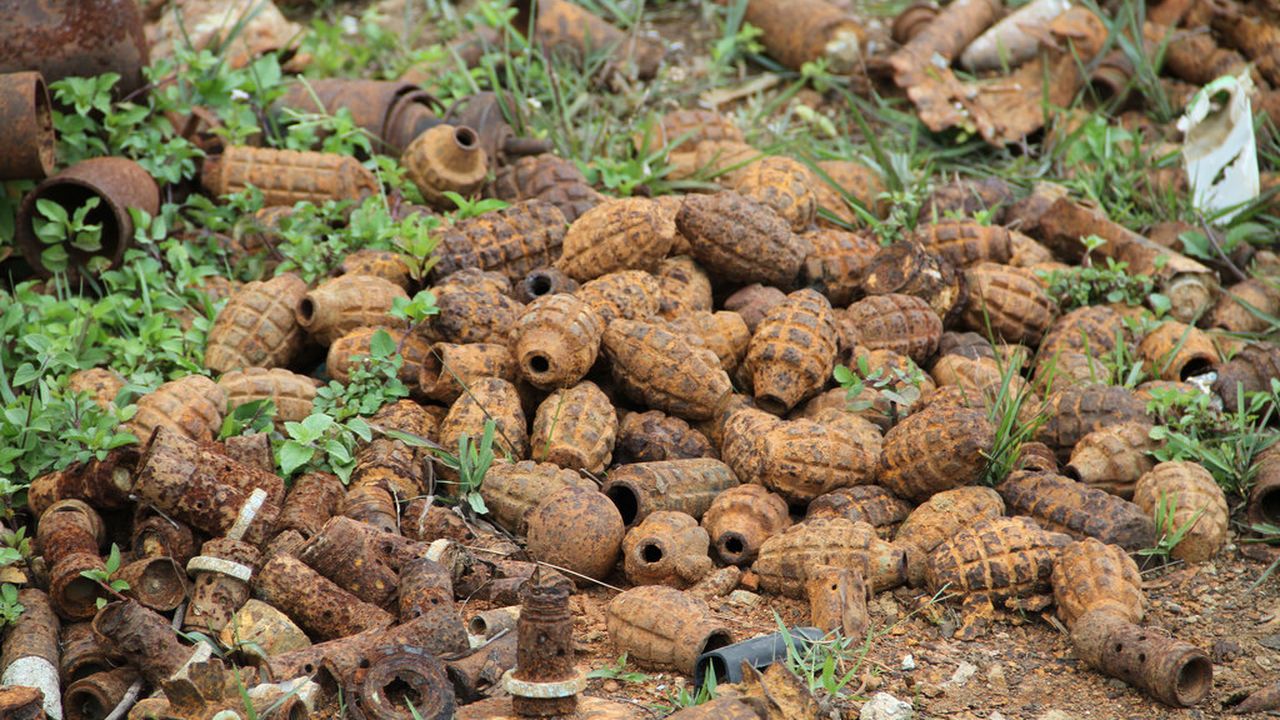
During the Vietnam War, central Laos was subject to one of the most intensive carpet bombing campaigns in history. Between 1964 and 1973, the USA dropped more bombs on the Plain of Jars than they did in the whole of WWII, and as many of 80 million of these remained unexploded after impact.
The USA dropped more bombs on the Plain of Jars (Photo: Collected)
Though the Plain of Jars is not a UNESCO World Heritage Site, the Lao government and UNESCO have worked together in recent years to clear these unexploded bombs. Nevertheless, many still remain and continue to provide a very real threat for locals and visitors to the area. Laos is considering putting the region up for World Heritage status, which would provide funds for further clearing, making way in turn for research efforts and tourism.
For now, the continued presence of unexploded bombs means you must be very careful to remain within designated viewing areas when visiting any of the jar sites.
2. Visiting the Plain of Jars
Phonsavan is the gateway to the Plain of Jars, and can be reached by aeroplane, car or bus. A bus from Vietiane to Phonsavan takes around 10-12 hours, and from either Vang Vieng or Luang Prabang takes around 8 hours.
The most visited sites are sites one, two and three, and these can be reached by motorbike or car. There are also lots of agents in Phonsavan who arrange tours of the three sites, as well as some other local sites of note – such as Hmong villages. Alternatively, you could hire a bicycle and make the 45-minute ride to site one – the most impressive of the three sites.
Entrance to each of the jar sites is 10,000 Kip (80p).
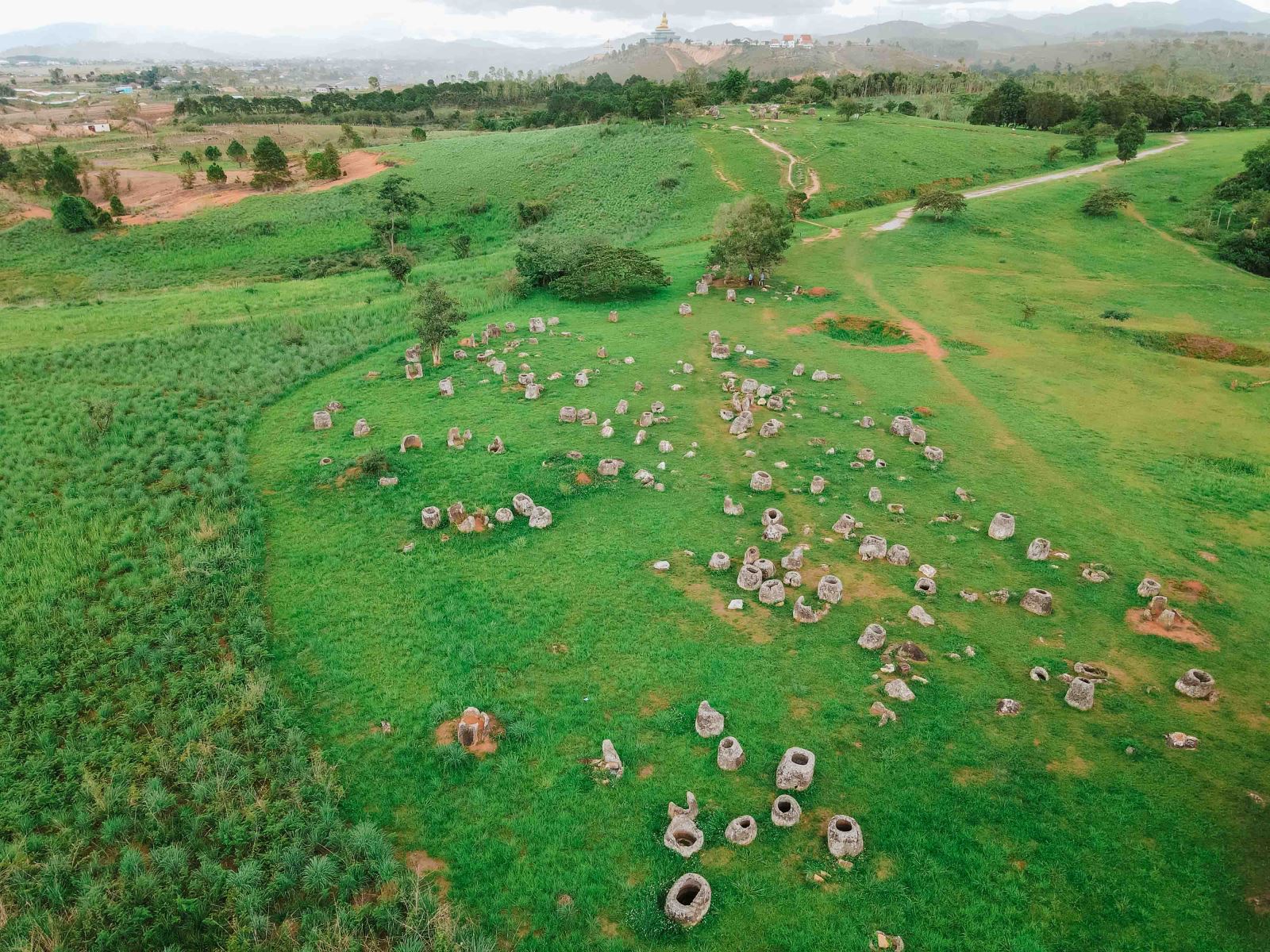
The Plain of Jars viewed from above (Photo: Collected)
Sometimes a destination just calls our name. Mysterious, giant, Stone Age jars scattered throughout the plains of Laos? Sounds like an adventure out of a movie to us, and we had to see it for ourselves during our visit in Laos. What we found most intriguing would be the unknown history of these megalithic monuments.
Though, there are theories, none have been proven to be 100% correct. The most common theory with supporting evidence claims these jars were used for burial rituals, whereas, a local myth is that giants used to roam these lands and use the jars to store their booze. Making a detour to see Laos’ version of Stonehenge was a no brainer for us. Not only would this be a beautiful place to photograph, but also a fun mystery history lesson.
You can reach the Plain of Jars from Phonsavan, a town in northeastern Laos. There are several sites to see, but due to UXOs you can only see sites 1-3. You can easily visit the 3 Plain of Jars sites in a day. You will have to pay roughly $50 to hire a driver to take you, or the more budget friendly way would be to rent a motorbike for $10 and drive yourself. We chose do DIY motorbike trip. The sites are all relatively close to eachother and easy to access. Beginner motorbikers should not have a problem on the roads, other than take care with patches of loose gravel.
We found ourselves in a race with the forecasted rain for the day, so we did the tour backwards visiting site 3 first and making our way to site 1. The rain never came, so it ended up being a perfect, cool day for exploring the Plain of Jars.
Phonsavan was also the second most bombed area in Laos during the war. The US dropped a bomb every 8 minutes for 9 years straight leaving this area loaded with bombs that never exploded UXOs. UXO’s (unexploded ordinance) are still, and will remain a huge problem for Laos. People, mostly farmers and scrap collectors, are still getting injured and killed to this day. You will notice restaurants and guesthouses using old bomb shells as décor. You will also see huge bomb craters inches away from some of the ancient jars at the sites. Since there are still UXOs you will want to follow the safe, clearly marked path by MAG at each of the sites. We strongly advise not wandering off of marked pathway.
>>> See more: Dong Natad National Protected Area
2.1. Plain of Jars: Site 1
Site 1 is closest to Phonsavan, and the most visited of the sites. There are over 300 jars scattered throughout the area of site 1. There is also an impressive cave you cannot miss. Inside the cave there are two man made holes at the top. It is said this cave was used as a crematorium for dead bodies, supporting the theory that the jars were used for burial practices. You also can’t miss the marked bomb craters from the war. Don’t miss the free visitor information center at the entrance of site 1 where you can learn a little bit about the Plain of Jars and the war.
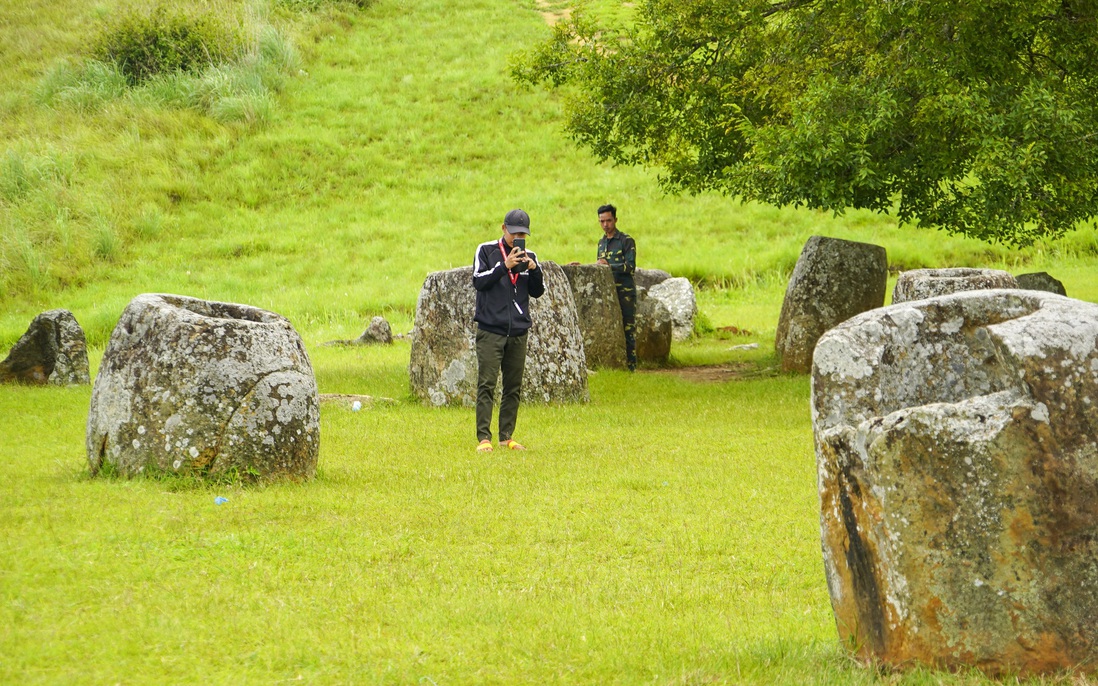
The Plain of Jars – a symbol of Vietnam-Laos friendship in Xieng Khouang (Photo: Collected)
Admission: 15,000 kip/person plus 3,000 kip for parking
2.2. Plain of Jars: Site 2
Site 2 offers a much smaller amount of jars than the other two sites. You will walk down a dirt road and discover there are two different sites to see on either side of the road. We first climbed up the stairs on the left hand side of the road to find a small cluster of jars hidden under some trees on top of a hill. One of the jars actually had tree roots growing around it, which was an interesting site and reminded us of the temples swallowed by trees at Ta Prohm in Angkor Wat.
After checking out these jars you can find a path leading back down the road where you will find more jars. On this side you will have gorgeous panoramic views of rice paddies and the plains. We continued passed the jars on this side and followed the MAG markers for about 30 minutes thinking we were going to see more jars, but actually were lead to a hill with more panoramic views and at least a dozen bomb craters. We got a little turned around trying to come back to the jars and almost walked off the path of the MAG markers and getting lost.
Not good, considering there are still UXOs out there. Luckily, we found our way back to the markers and made our way back to the entrance of site 2 for a delicious noodle soup lunch.
Admission: 10,000 kip/person
2.3. Plain of Jars: Site 3
Site 3 is just a short drive from site 2. To get to the jars at site 3 you have to walk through rice paddies up a small hill. From here you have attractive views of the surrounding, lush, green hillsides. This was our favorite of the three sites because of the size of the jars and the location. We were in a small, fenced in area surrounded by green, rolling hills and clusters of jars.
There were a few local kids playing in the jar site until we arrived. Being shy, they said hello, giggled, and ran away. We spent about an hour photographing and enjoying the site without anyone else there with us. We liked the more quiet experience we had here all to ourselves.
Admission: 10,000 kip/person
>>> See more articles:
Laos Travel – Hidden Beauty and Captivating Destinations Every Traveler Should Explor
Or Lam – The Soul-Warming Traditional Stew of Luang Prabang, Laos
Laos Cuisine: Sticky Rice and Noodle Soups