





Top 4 National Parks and Protected Areas in Laos

Today’s article will take you on a journey through some of the most remarkable National Parks and Protected Areas in Laos. From lush tropical forests and dramatic limestone landscapes to diverse wildlife and unique ecosystems, these protected areas showcase the country’s rich natural heritage. Let’s explore their beauty, biodiversity, and potential for eco-tourism.
1. Learn about National Parks and Protected Areas in Laos
Lao has 20 National Protected Areas that cover almost 14% of the country. These reserve areas offer a range of ecotourism attraction with their vast zones of tropical monsoon forest, diverse wildlife and stunning karst limestone formations. However, not all protected areas are accessible to the public despite their great potential for ecotourism.
2. Dong Amphan: A Wilderness of Forests and Wildlife
Don Amphan. Don Amphan is situated in the north-east part of Attapu province. It is mainly hilly, but the elevations rise up to 2000 m particularly at Phou Pengmun. Don Amphan vegetation can be characterized as semi-evergreen forest and dry evergreen forest with patched of secondary vegetation due to shifting cultivation. The hills are steep and sharp and rise to various streams and rivers thus create a small flood plain. The area is inhabited by species like Asiatic golden cat, buff-cheeked gibbon, and douc langur, fishing cat, clouded leopard, tiger and small populations of Asian elephants. This protective area is also considered as an International Bird area with about 280 species of bird including buceros bicornis, brown hornbill, black-hooded launghingthrush, white-cheeked laughingthrush, and grey-faced tit babbler.
The subsistence hunting and commercial hunting are big threats to the biodiversity at Dong Amphan. The clearance of forest through shifting cultivation impinge the old-growth forest within the protected area and thus resulted in succession by fire-climax pine woodland in some areas.
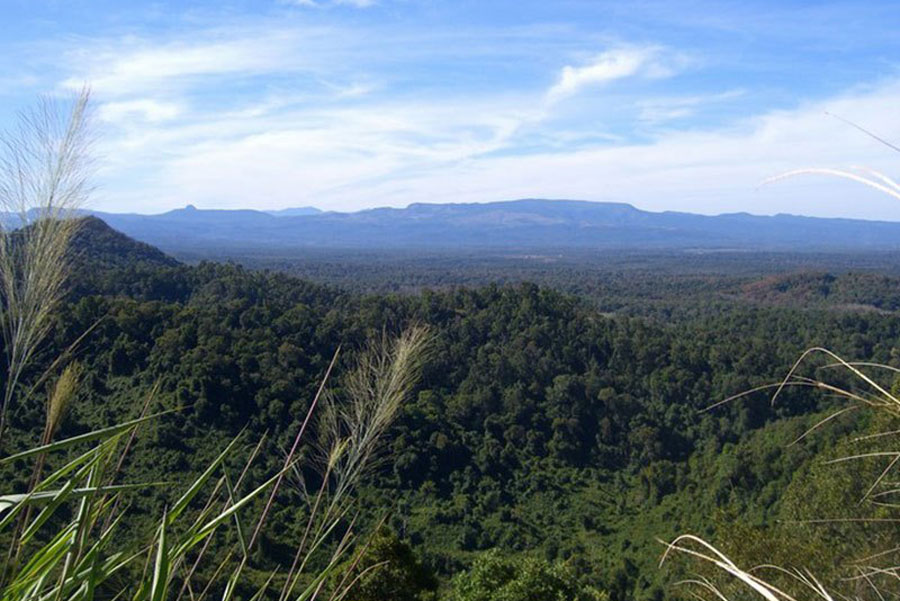
Dong Amphan (Photo: Collected)
The access to the reserve is mainly limited during the dry season. It can be reached using Xe Kaman and Xe Xou route, which are navigable by boat for a considerable distance. The road from Attapeu to Xanxai district is used to access the main route to the northern section of the protected area. The core of Dong Amphan is only accessible by foot. There are well- established walking trails interconnecting villages surrounding the area.
3. Dong Hua Sao: The Biodiversity of the Bolaven Plateau
Dong Hua Sao. Dong Hua Sao covers an area of 1,100 sq km. This protected area is located in the province of Champasak within the districts of Bachieng, Pakxong and Pathoumphon. The lowland plains comprise over half of the protective area with the elevation ranging from 100 to 1000 m. The area’s vegetation consists mainly of evergreen forest in the lowlands and the uplands with dry dipterocarp forest and mixed deciduous forest. Most of the upland areas form a part of Boloven Plateau. The climate within the area is characterized as tropical monsoon with high rainfall and a distinct dry season. The temperature in the highest elevation level occasionally reaches sub-zero level. Within the park dwells a significantly low population of key species wildlife such gaur, sambar deer, common muntjak, wild boar, smooth otter, civet, leopard cat and squirrel. There are also 26 species of birds and 41 species of reptiles and amphibians seen in the protected site. The area is also inhabited by Attacus atlas, a family of atlas moth. Atlas moths are the largest moths in the world in terms of wing surface area.
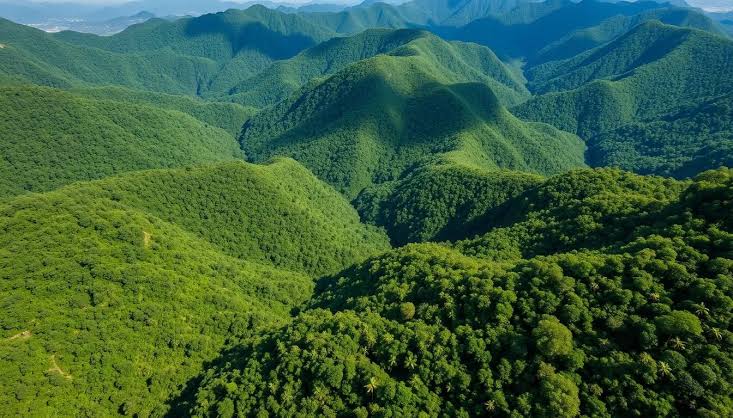
Dong Hua Sao: The Biodiversity of the Bolaven Plateau (Photo: Collected)
Dong Hua Sao is the only declared National Biodiversity Conservation Area (NBCA) that protects semi-evergreen forests of the Bolovens Plateau. The conversion of mature forest to establish coffee plantation, the commercial hunting and the unrestrained collecting of forest products are the major threats on the conservation of this protected areas.
Dong Houa Sao can be access from major hard-top, all weather roads from route 13 south and from Pakse-Paksong in the north. There is also access road in coffee plantation towards the remote sections of the uplands. Lowland flats can be reached by old logging roads.
4. Hin Namno: Limestone Karst and Rare Wildlife
Hin Namno. Hin Namno is protected nature reserve in Khammouane Province in the central Laos. Its topography features limestone karst formation, scattered with undulating limestone hills and valleys. The area is dominated sparsely vegetated limestone karst, with semi-evergreen forest, mixed deciduous forest, secondary forest, shifting cultivation and bamboo forest. Hin Namno is the only wet evergreen forest on limestone in Laos. A total of 45 species of mammals are recorded seen in the area, in which 10 of those are listed as Globally Threatened. There are also species of primates dwelling in the area such as douc langur and francois’s langur. There are also 25 species of bats identified including great evening bat, horsfield fruit bat and harlequin bat. The large-antlered Muntjak or Giant Muntjac also inhabits in Hin Namno.
Hin Namno is an important bird area, with 217 bird species have been identified here. There is a significant proportion on the population of Sooty Babbler, a species endemic to limestone areas in central Laos and central Vietnam. Crested Argus, Siamese firebacks, lesser fish eagle, spot-billed pelican also lodge in the protected site. There is also the presence of four species of hornbills; brown hornbills, great hornbills and rufous-necked hornbill and wreathed hornbill.
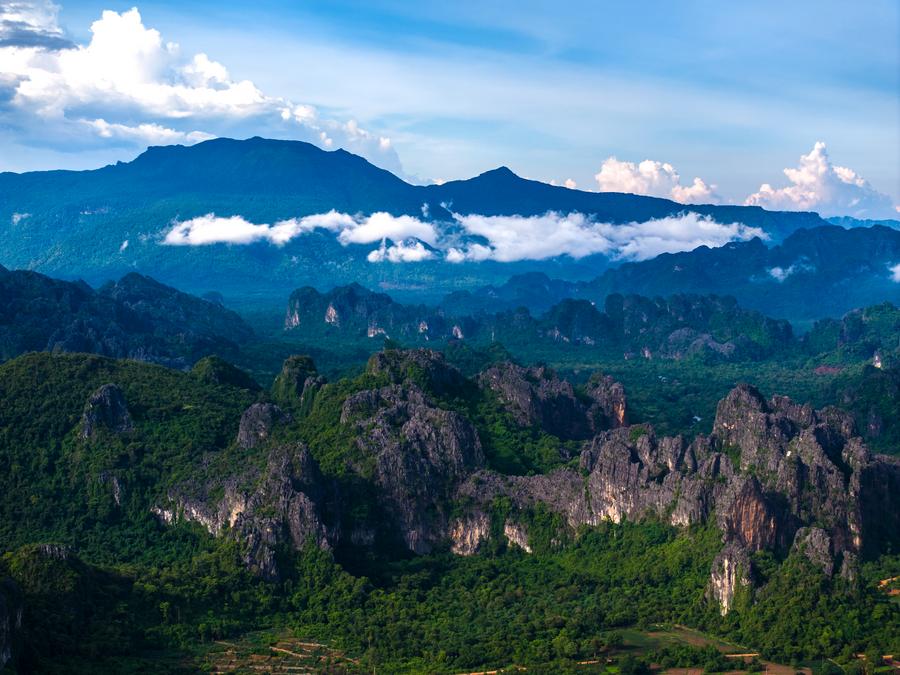
Visit to Laos’ Hin Nam No National Park-Xinhua (Photo: Collected)
There are 46 species of reptiles that believed to be common in the Hin Namno, this include the 6 species of turtles – Asiatic softshell, Asian leaf turtle, keeled box turtle, wattle-necked softshell, and yellow-headed temple turtle. There are also 130 species of fish that have been collected in Xe Bang Fai River within the protected area.
The most serious threats in the Hin Namno are the human intrusion and non-timber forest product (NTFP) collection such a rattan collection. There also unexploded ordinance that is a major risk for people and animals residing in the area. The increasing shifting cultivation particularly in upland as well as floods and droughts may also affect the conserved area.
Hin Namno offers a great eco-tourism potential with its beautiful forest and 6 km tunnel near Muang Boualapha, however the area has the limited access. The access to Muang Boulapha takes approximately five hours and access to Hin Namno requires both truck and about 9-hour boat ride and particularly difficult during rainy season.
5. Nakai-Nam Theun: One of Southeast Asia’s Last Wildernesses
Nakai-Nam Theun. Nakai-Nam Theun is a protected area that covers approximately 3.445 sq km of the Annamite Mountains and the adjacent Nakai Plateau in the provinces of Bolikhamxay and Khammouane. This protected site comprises one of the most unspoiled wildernesses in Southeast Asia. The topography of the area is characterized as rugged and dominated by main ridge of the Annamite Mountains. Phou Laoko is the highest point on the ridge with 2,286 m. The vegetation of the area is complex. The dry evergreen forest dominates up to 1,800 m consisting of species of dipterocarpus and myristicaceae, annonaceae and other plants. Motane fagaceous forest mantle the slopes, interspersed with patches of Fokienia hodginsii (cypress-like conifer). Fagaceous forest above 2,000 m sea level and mountain tops gives way to cloudforest. Cloudforest is dominated by rhododendron ericaceous that grew about 7 m tall. Within its riverine forest is the tree species of Poikilospermum (Urticaceae). There is also a large variety of herbs and habitat of unknown floras.

Nakai Nam Theun National Protected Area: Laos (Photo: Collected)
The area is significantly important for conservation of more than 300 species of birds in which 52 species are restricted to Sino-Himalayan subtropical forest and 18 species restricted to the Indochinese Tropical Moist Forest. The area supports the largest population of rufous-neck hornbills in Indochina. There are also large number of endemic crest Argus and short tailed scimitar babbler. Other species of birds residing in the area are Siamese fireback, red-collared woodpecker, great hornbill, brown hornbill, Blyth’s kingfisher, lesser fish eagle, Japanese paradise-flycatcher, beautiful nuthatch, and yellow-vented warbler.
The site also has the most documented species of large mammal community in the country including the Asian elephant, giant muntjac, and gaur bos gaurus. Dwelling within the area are 100 species of mammals including 45 species of bats and 8 species of rodents. There are also 53 species of reptiles and amphibians. Globally threatened animals residing in the area are pygmy loris, douc langur, and pale-cheeked gibbon.
Route 8B is the only main road that enters the heart of the reserve. Route 8B is around Ban Kendaeng of Khamkeut District to Ban Thamuang towards Ban Navang. Nakai-Nam Theun can also be reached from Thakek via route 12.
Ready to Discover the Hidden Beauty of Laos?
If you’re planning to explore the heart of Indochina—especially the enchanting country of Laos—consider joining our LAOS REVEALVED TOUR 4D3N for an unforgettable journey. Experience the timeless charm of ancient temples, majestic mountains, untouched nature, breathtaking landscapes, and the warm hospitality that makes the Lao people so welcoming. Let Focus Asia Travel help you discover the very best of Laos with a carefully designed itinerary and professional travel services.
Contact Focus Asia Travel for a FREE consultation:
Hotline: +84 793 113 879 / +84 78 2323 879 / +84 93 645 9995 / +84 93 617 9995
Email: customer@focusasiatravel.com / sales@focusasiatravel.vn
Websites:
- http://focusasiatravel.vn
- https://focusasiatravel.com
- https://nhatrangtravel.info
- https://hochieuvisa.vn