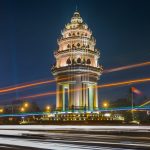






Independence Monument in Phnom Penh, Cambodia

At the heart of Phnom Penh, the Independence Monument, designed by Vann Molyvann and inaugurated in 1962, commemorates Cambodia’s restored sovereignty..
Standing at the center of a large roundabout in Phnom Penh, the Independence Monument rises with its stone lotus silhouette at the intersection of Sihanouk and Norodom Boulevards. Designed by Cambodian architect Vann Molyvann and inaugurated on November 9, 1962, it commemorates the end of French protectorate rule and remains a central landmark of the capital today.
1. Why Visit the Independence Monument
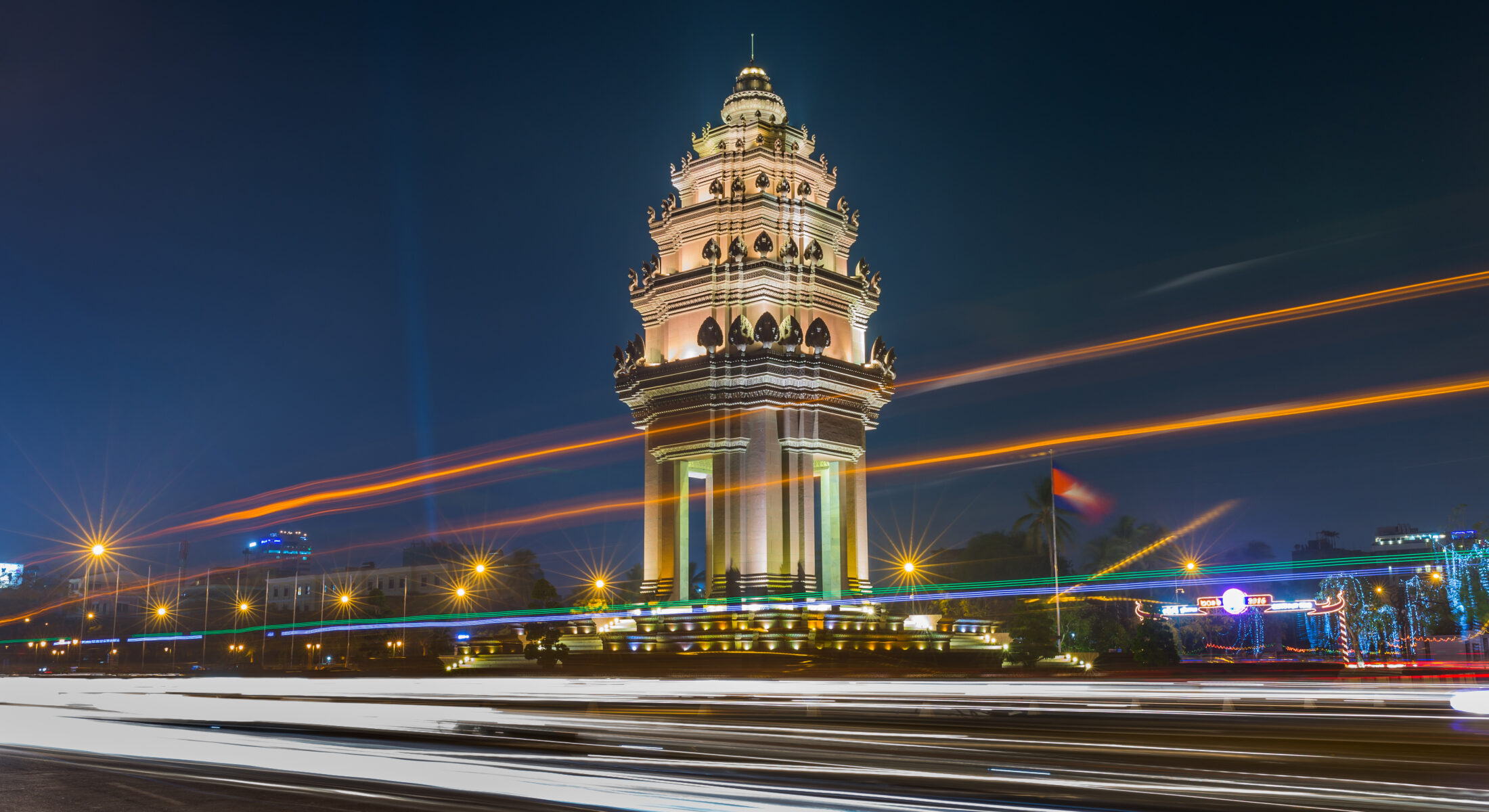
Independence Monument (Photo: Collected)
The site offers a twofold appeal. Architecturally, it exemplifies the New Khmer Architecture movement of the 1960s, which reinterpreted Angkorian vocabulary using modern materials.
Symbolically, it marks Cambodia’s attainment of sovereignty in 1953 and serves as an official gathering point during major national commemorations. Its central location also makes it a useful landmark for navigating Phnom Penh: the Royal Palace, Wat Botum, and the banks of the Tonlé Sap are all within short distance.
2. History of the Monument

Norodom Sihanouk (Photo: Collected)
King Norodom Sihanouk abdicated in 1955 to focus on politics and champion the cause of an independent nation. A few years later, he commissioned a group of Khmer architects to design a monument embodying this new sovereignty. Work began in 1958, and the structure was inaugurated on November 9, 1962, the anniversary date of independence proclaimed in 1953.
The building has survived decades marked by civil war, the Khmer Rouge regime, and reconstruction. It remains one of the few modern monuments in Phnom Penh to have retained its original symbolic function.
Vann Molyvann, the Architect

Vann Molyvann, Architect Who Shaped Cambodia’s Capital (Photo: Collected)
Born in Kampot in 1926, Vann Molyvann was among the first Cambodian architects trained abroad—in Paris, in his case. Upon his return, King Sihanouk appointed him Chief of Public Works and State Architect.
In addition to the Independence Monument, he designed the Phnom Penh Olympic Stadium, completed in 1964, several university buildings, and the National Theatre. His work is today the subject of preservation campaigns led by the Vann Molyvann Project.
3. What You’ll See On Site
The monument stands 20 meters high and takes the stylized form of a lotus, a direct reference to Angkor’s stupas. Its structure comprises five successive levels, adorned with nāga heads (serpent protectors from Khmer mythology). At the summit, one hundred nāga heads crown the edifice.
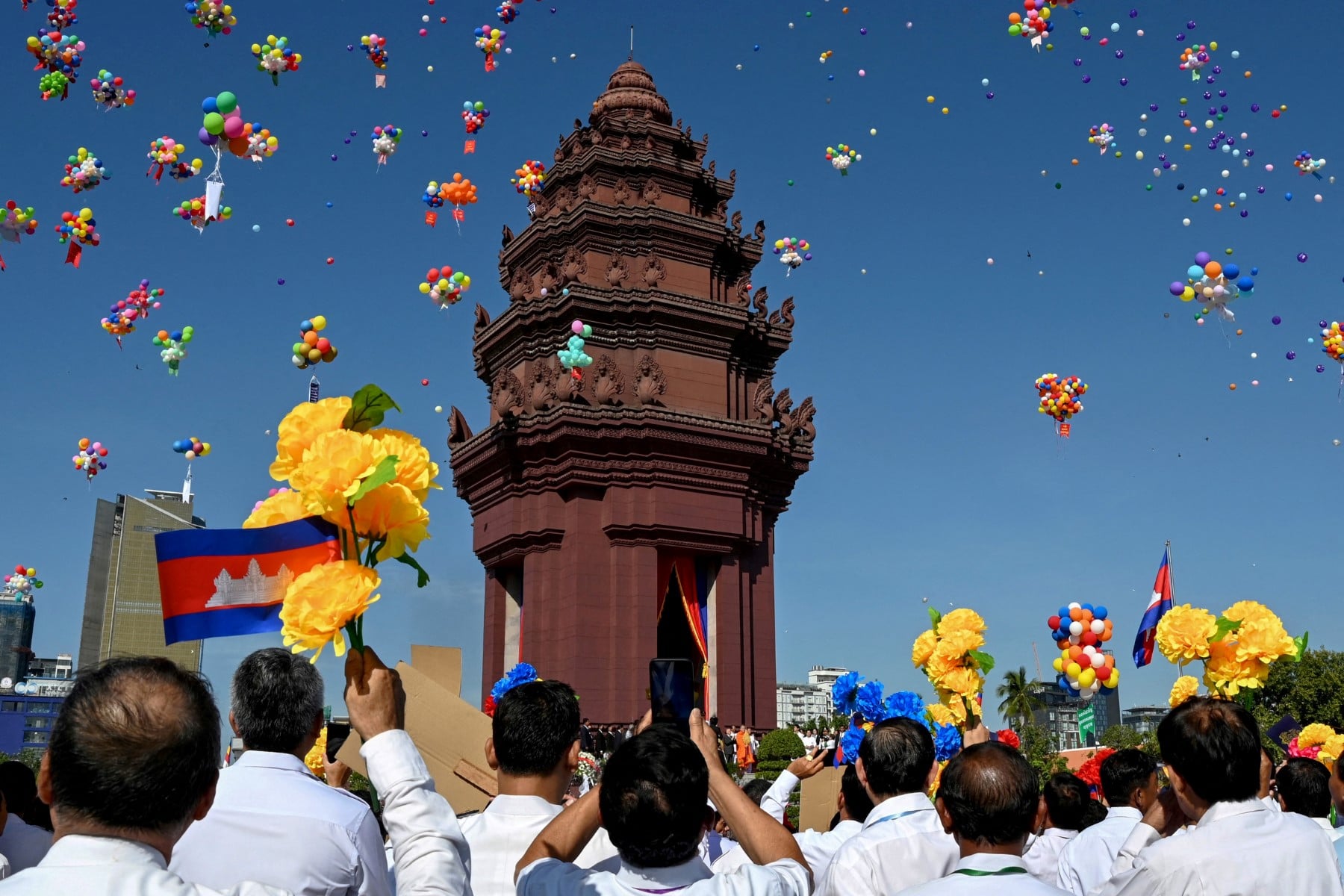
The Independence Monument in Phnom Penh: A Symbol of Cambodia’s Resilience (Photo: Collected)
The entire structure is built in reinforced concrete, a modern material paired with decorative techniques rooted in traditional sculpture.
- Height: 20 meters
- Architect: Vann Molyvann
- Inauguration: November 9, 1962
- Style: Angkorian inspiration (stupa-lotus), modern materials
- Visiting: exterior only; the interior is not open to the public
The adjacent esplanade, laid out as a garden, houses the statue of King Norodom Sihanouk, unveiled after his passing. It offers a fine vantage point for photographing the monument and allows you to combine both visits in a short walk. After dark, the building is illuminated, making it a popular stopping point in the early evening.
4. When to Visit
The monument is visible year-round. Two dates concentrate official activity:
- November 9 — Independence Day. A flame is lit at the base of the monument and flowers line the steps. Official ceremonies and gatherings take place on site.
- September 24 — Constitution Day. The monument also serves as a gathering point.
Outside these dates, late afternoon remains the most pleasant time to visit: the low-angle light showcases the lotus silhouette, and evening lighting then takes over. The dry season, from November to March, offers the most comfortable conditions for a leisurely stroll in the area.
5. Practical Information
- Access: free; monument visible at all times from outside (no enclosure)
- Admission: free
- Duration: 15 to 30 minutes suffice to walk around and photograph the building; allow 1 hour if you extend to the esplanade and Sihanouk’s statue
- Accessibility: sidewalks around the roundabout; watch for heavy traffic when crossing
6. How to Get There
The monument is located at the intersection of Norodom and Sihanouk Boulevards, in the heart of Phnom Penh. From the Royal Palace, allow about 10 minutes on foot heading up Norodom Boulevard.
Tuk-tuks and ride-sharing services like PassApp or Grab easily serve the area. The roundabout is heavily trafficked: for photography, it’s better to use the peripheral sidewalks or the adjacent esplanade rather than cutting across the center.
7. Nearby Attractions

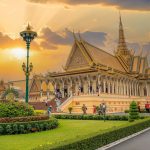
Royal Palace Park (Phnom Penh, Cambodia) (Photo: Collected)
- Royal Palace and Silver Pagoda — 10 minutes on foot to the north
- Esplanade and statue of Norodom Sihanouk — adjacent to the monument
- Wat Botum and its park — in immediate vicinity
- Tonlé Sap waterfront (Sisowath Quay) — 15 minutes on foot
To further explore modern and ancient Cambodge, the Bayon Temple at Angkor remains essential for understanding the monument’s stylistic inspiration.
8. Planning Your Phnom Penh Visit
The Independence Monument fits naturally into a circuit of central Phnom Penh’s historic sites, alongside the Royal Palace, the National Museum, and the Tonlé Sap waterfront. To craft a comprehensive Cambodia itinerary combining the capital, Angkor, and southern regions, explore Focus Asia Travel Cambodia travel suggestions.
Read more: