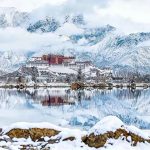






Potala Palace – The Legendary Palace in the Heart of Tibet


Rising dramatically above the city of Lhasa, Potala Palace is one of the most extraordinary landmarks in Tibet. Built against the slopes of Marpo Ri Hill, the palace combines monumental architecture, Tibetan Buddhism, history, and breathtaking mountain scenery.
For centuries, Potala Palace served as the winter residence of the Dalai Lamas and the political and religious center of Tibet. Today, it is one of the most recognizable symbols of Tibetan culture and one of the most remarkable historical sites in Asia.
🏔️ The History of Potala Palace

The history of Potala Palace dates back to the 7th century, when King Songtsen Gampo of the Tibetan Empire built an early palace on Marpo Ri Hill.
The palace complex as visitors see it today was developed mainly from the 17th century, during the reign of the Fifth Dalai Lama. Construction began in 1645, and the palace gradually expanded into the enormous complex that dominates Lhasa today.
Potala became the winter residence of successive Dalai Lamas and an important center for both Tibetan religious and political affairs.
Its long history has made the palace an invaluable symbol of Tibet’s cultural heritage.
🏯 The Red Palace and White Palace

One of the most fascinating features of Potala Palace is its distinctive architectural composition.
The complex is broadly divided into two major sections:
The White Palace served mainly as the living and administrative area of the Dalai Lama and his entourage.
The Red Palace is the spiritual heart of Potala, containing numerous Buddhist chapels, prayer halls, sacred statues, murals, and stupas.
The contrasting white and deep red colors create the palace’s iconic appearance against the mountains and blue Tibetan sky.
🛕 A Sacred Center of Tibetan Buddhism

Potala Palace is far more than an ancient royal residence. It is one of the most important sacred sites in Tibetan Buddhism.
Inside the palace are numerous prayer halls and chapels decorated with intricate murals, Buddhist statues, religious objects, and traditional Tibetan artwork.
One of the most remarkable features is the collection of golden stupas containing the remains of several Dalai Lamas.
The atmosphere inside is solemn and deeply spiritual, offering visitors a glimpse into centuries of Tibetan Buddhist traditions.
🎨 Magnificent Tibetan Art and Architecture

Walking through Potala Palace feels like entering a living museum of Tibetan art.
The interior contains beautifully preserved murals, thangka paintings, sculptures, religious manuscripts, wood carvings, and traditional decorations.
Many of the murals depict Buddhist stories, historical events, religious figures, and scenes from Tibetan life.
The intricate details demonstrate the extraordinary craftsmanship of generations of Tibetan artists and artisans.
🪜 The Journey to the Palace

Reaching the upper sections of Potala Palace requires climbing a considerable number of steps.
Although the climb can be physically demanding, particularly because Lhasa sits at an altitude of around 3,650 meters above sea level, the journey is part of the experience.
As visitors ascend, the view over Lhasa gradually opens up. The whitewashed buildings, surrounding mountains, prayer flags, and expansive Tibetan sky create an unforgettable atmosphere.
Travelers should take their time and allow themselves to adjust to the high altitude.
🌄 Panoramic Views of Lhasa

From the palace grounds, visitors can enjoy spectacular views across Lhasa.
The contrast between the historic palace, traditional Tibetan architecture, modern parts of the city, and distant mountains creates a fascinating panorama.
On clear days, the high-altitude sunlight makes the landscape particularly vivid, with deep blue skies and dramatic shadows across the mountains.
🌅 Potala Palace at Sunrise and Sunset

Potala Palace changes character throughout the day.
At sunrise, the first rays of light illuminate the palace walls, creating a magnificent golden glow against the mountains.
At sunset, the white and red buildings become warm and dramatic as the sky changes color.
These moments are especially popular among photographers because they highlight the palace’s monumental scale and unique position above Lhasa.
🌍 A UNESCO World Heritage Site

Potala Palace was recognized as a UNESCO World Heritage Site in 1994, reflecting its outstanding historical, architectural, and cultural importance.
The UNESCO designation was later extended to include other important historical sites in Lhasa.
Today, strict preservation measures help protect the palace’s architecture, artwork, religious treasures, and historical character for future generations.
📸 One of the Most Iconic Views in Tibet

Potala Palace is arguably one of the most recognizable images of Tibet.
The traditional way to photograph the palace is from Potala Palace Square, where visitors can capture the entire structure rising above the city.
Another popular viewpoint is Longwangtan Park, where the palace can sometimes be photographed with its reflection on the water.
The combination of the palace’s dramatic architecture and the surrounding Himalayan landscape makes it a dream destination for photographers.
✨ Why Should You Visit Potala Palace?
Potala Palace offers a journey through Tibetan history, Buddhism, art, architecture, and spirituality all at once.
Standing before the enormous palace, climbing its ancient steps, discovering centuries-old Buddhist artwork, and looking across the high-altitude landscape of Lhasa creates an experience that is difficult to compare with any other destination.
For travelers exploring Tibet, Potala Palace is not simply another sightseeing attraction—it is the cultural and spiritual symbol of the Tibetan Plateau.
🏔️ Potala Palace – Where history meets spirituality above the rooftops of Lhasa.
Discover the legendary palace, admire magnificent Tibetan art, and experience the timeless atmosphere of one of Asia’s most extraordinary cultural landmarks. ✨🛕